 Skip to content


Table of Contents
- How to Choose Community Art Classes for Adults in Houston
- Beginner Art Classes for Adults: What No-Experience Classes Actually Cover
- Adult Painting Classes: Watercolor, Oil, and Acrylic Compared
- Adult Drawing Classes: The Foundation Skill That Improves Everything Else
- Art Workshops for Adults: Short Sessions, Ceramics, and One-Night Events
- What to Ask Before You Register
- What to Expect in Your First Class and What to Bring
- Conclusion
- Frequently Asked Questions
Last Updated: October 5, 2026
How to Choose Community Art Classes for Adults in Houston
Community art classes for adults are instructor-led, non-credit studio courses that teach a specific medium, from drawing and painting to ceramics and printmaking, usually through parks departments, museums, or independent studios. The fix: choose by goal and schedule first, medium second.
Start With Your Goal, Not the Medium
Decide what you want from the class before browsing the catalog.
- Skill building: Choose a progressive course that runs six to ten weeks, not a one-night event.
- Stress relief: Pick a low-stakes workshop where the finished piece matters less than the process.
- Social connection: Look for recurring studio sessions with the same group each week.
Most programs publish a course description, materials list, and skill level. Read all three. If a listing says "all levels," email the instructor and ask how they split attention between first-timers and returning students.
Match the Format to Your Week
Format matters more than medium for busy adults. A class you can't attend consistently is one you'll drop.
Format |
Typical Length |
Best For |
Watch Out For |
|---|---|---|---|
One-night workshop |
2-3 hours |
Trying a medium before committing |
Little skill progression |
Multi-week course |
6-10 weeks |
Building real technique |
Missed sessions are hard to make up |
Drop-in studio session |
2-4 hours |
Flexible schedules |
Less structured instruction |
Online or hybrid class |
Varies |
Travel limits, irregular hours |
Requires a home setup |
If your evenings shift week to week, a drop-in or online option beats a fixed multi-week course. If you learn best with hands-on correction, in-person studio time is worth rearranging your calendar for.
Beginner Art Classes for Adults: What No-Experience Classes Actually Cover
Beginner art classes for adults assume zero prior training and cover fundamentals: line, shape, value, proportion, and color mixing. A common mistake is expecting a polished painting in week one. You won't get one.
Beginner classes vary enormously in ambition. Some are social and loose; others quietly teach art-school foundation fundamentals at a slower pace.
Adult Painting Classes: Watercolor, Oil, and Acrylic Compared
Adult painting classes split into three mediums, each rewarding a different temperament. Watercolor dries fast and punishes hesitation. Oil gives you hours to rework a passage but needs solvents and ventilation. Acrylic sits in the middle: quick-drying, water-cleanup, and forgiving for beginners.
Which Paint Matches Your Patience Level
- Watercolor: Best for planners who enjoy transparency and light. Mistakes are hard to erase, so it suits people comfortable working carefully.
- Oil: Best for tinkerers. You can blend and revise for days. Expect longer drying times and a materials list that includes proper ventilation.
- Acrylic: Best for beginners and anyone short on time. It dries quickly, layers well, and cleans up with water.
If unsure, start with acrylic and move to oil once you understand value and color mixing. Many studios run short introductory workshops in all three, the cheapest way to find your fit before committing to a term.
Adult Drawing Classes: The Foundation Skill That Improves Everything Else
Adult drawing classes teach observation before style, and that skill transfers to every other medium. Drawing is the backbone of painting, ceramics design, and printmaking.
Expect graphite or charcoal, timed gesture studies, and still-life setups. Anatomy, perspective, and shading usually appear in intermediate courses. A structured drawing course feels repetitive at times; that repetition is the point.
Art Workshops for Adults: Short Sessions, Ceramics, and One-Night Events
Art workshops for adults are short-format sessions, often a single evening or weekend, built around one project or technique. They're the lowest-risk way to test a medium before committing to a term. Ceramics and pottery workshops are the most popular entry point by a wide margin, followed by jewelry, glass art, printmaking, and mixed media.
Ceramics and Pottery: The Two Tracks
Ceramics splits into two distinct skills, and most studios teach them separately:
- Wheel throwing: Centering clay on a spinning wheel, then pulling walls. It's physical, meditative, and humbling. Most beginners ruin their first several attempts at centering, which is normal. A one-night wheel workshop usually gets you two or three throws and one piece you keep.
- Handbuilding: Pinching, coil, and slab construction. No wheel required, far more forgiving, and better for sculptural or functional pieces like mugs, trays, and planters. Handbuilding workshops tend to produce a finished-looking piece in a single session more reliably than wheel sessions do.
The Firing Timeline Nobody Mentions
Here's what surprises first-timers: you almost never take your piece home the same day. Greenware has to dry, then go through a bisque firing, then get glazed, then a glaze firing. In a busy studio, that cycle commonly runs two to four weeks. Some studios ship finished pieces or hold them for pickup; others charge a separate firing fee per piece.
Workshop vs. Term Course: What You Actually Get
Format |
Typical Length |
What You Learn |
What You Leave With |
|---|---|---|---|
One-night workshop |
2-3 hours |
One technique, one project |
One piece (often picked up later) |
Weekend intensive |
6-12 hours over 1-2 days |
A technique plus some repetition |
One or two pieces, real muscle memory |
Multi-week course |
6-10 weeks |
Centering, trimming, glazing, firing in sequence |
A shelf of your own work |
If you want a fun Friday, book the workshop. If you want a shelf of your own work by spring, enroll in the term course. The workshop teaches you whether you like clay; the course teaches you to work it.
Other Short-Format Workshops Worth Knowing
- Jewelry: Metalsmithing, wire wrapping, and beading. Often the most tool-intensive, so studios usually supply everything.
- Glass art: Fusing and mosaic are common; torch work and blowing are less so and require more safety infrastructure.
- Printmaking: Block printing and monotype are the friendliest entry points; screen printing needs a washout booth most small studios don't have.
Seasonal Timing
Spring and fall terms fill fastest. Summer sessions often run on condensed schedules, and January is the busiest enrollment month for adult workshops as people act on new-year intentions. If a specific workshop matters, register the day the catalog opens.
What to Ask Before You Register
Registration pages rarely answer the questions that decide whether you'll stay enrolled. Most catalogs list a tuition figure and a course description and stop there. The gap between that listing and the real commitment is where adults get surprised. Here's what to ask.
Cost: The Listed Tuition Is Rarely the Full Number
Community art class pricing varies by format and medium, but the pattern is consistent: advertised tuition covers instruction, and everything else is separate.
- Materials fees: Common for ceramics (clay, glaze, firing), printmaking (ink, paper, plates), and jewelry (metal, stones). Often charged per term or per piece.
- Supply kits: Some studios bundle a required kit into tuition; others hand you a list and expect you to shop. A kit is usually cheaper and better matched to the instructor's method.
- Firing charges: In ceramics, firing is sometimes included and sometimes billed per piece or per shelf. This is the single most common surprise charge.
Ask: "What is the total I'll pay from registration through the last class, including materials and firing?" A studio that can answer that in one sentence runs a tight program.
Class Size and Instructor Access
Class size is the strongest predictor of individual correction. Ask how many students per instructor and how many assistants are in the room. A drawing class of eight with one instructor gets more hands-on feedback than a painting class of twenty with one instructor and a volunteer. Also ask how long the instructor has taught adults specifically; teaching children and adults are different skills, and adult learners want rationale, not just demonstration.
Refunds, Transfers, and Missed Sessions
Life happens. Ask three things:
- What is the refund window, and is there a cancellation fee?
- Can I transfer to a later term if my schedule changes?
- If I miss a session, is there a make-up class, a recorded session, or open studio time I can use instead?
Multi-week courses rarely prorate for missed sessions. Drop-in and open-studio formats are more forgiving by design.
Accessibility, Parking, and Getting There
Almost no catalog answers this, and it decides whether some adults can attend at all. Ask directly:
- Is the studio step-free, and are entrances, restrooms, and work tables wheelchair accessible?
- Are there accommodations for hearing, vision, or mobility needs, and how far in advance should I request them?
- Is there on-site parking, and is it free or validated? Is there a drop-off point near the entrance?
If a studio can't answer these, that's information too.
Flexible Formats
If your schedule shifts week to week, ask whether the studio offers online or hybrid sections, asynchronous video instruction, or open studio hours without a scheduled class. Online works well for drawing, design, and lecture-heavy content. It works poorly for ceramics, glass, and anything requiring a wheel, kiln, or torch, since you can't replicate the equipment at home.
What to Expect in Your First Class and What to Bring
Your first class is usually orientation plus a short warm-up, not a finished artwork. Instructors cover studio rules, tool locations, safety, and a demonstration, then set you working on a simple study.
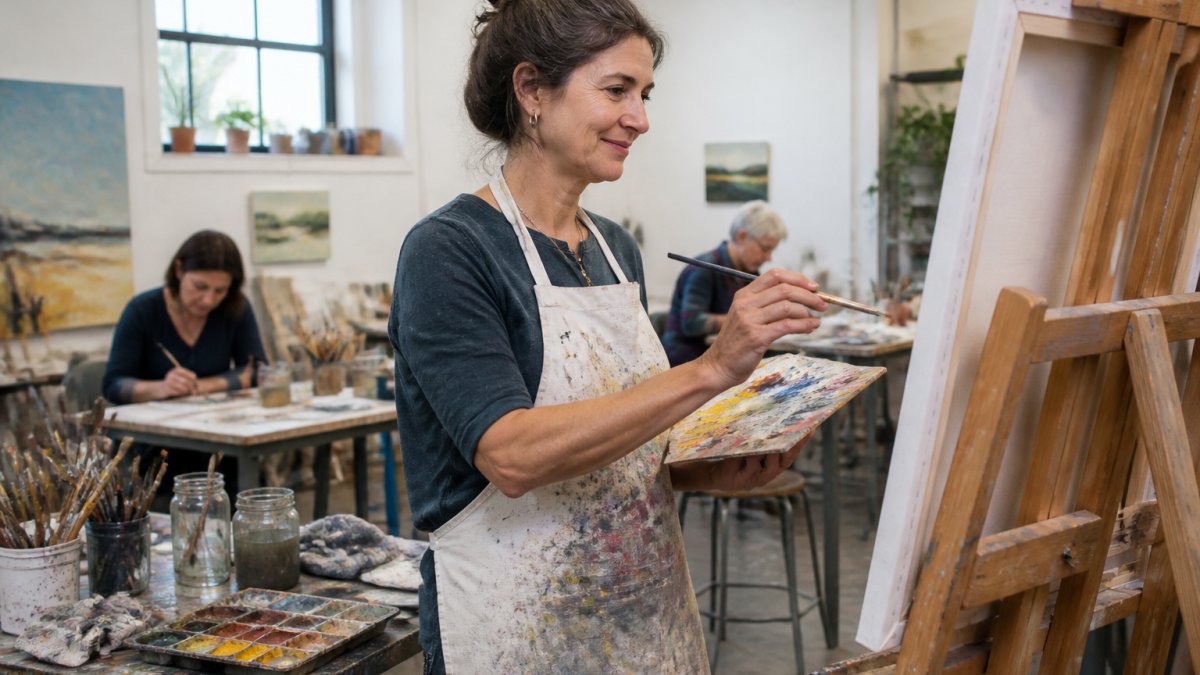
An adult student in a paint-splattered apron standing at an easel in a bright art studio, palette and brushes in hand, other students working at nearby tables
Your First-Class Checklist
- Confirm the materials list and whether supplies are provided or purchased
- Wear clothes you don't mind marking, or bring an apron
- Bring a notebook for notes and quick sketches
An apron earns its place fast. RedBlueArts offers an embroidered apron in a polyester-cotton blend with two front pockets and adjustable ties, and an organic cotton apron with a large two-compartment front pocket. A spiral notebook with 140 dotted pages handles notes and thumbnail sketches, and a tote bag carries brushes, a sketchbook, and a water bottle between studio and home.


Conclusion
Choosing well comes down to matching your goal, schedule, and patience level to the right format, then asking the questions most people skip until it's too late. RedBlueArts runs studio-based instruction for adults at every level, with mentorship from contemporary artist Gopaal Seyn, more than 25 years of artistic and educational experience, and flexible online and in-person options.
Frequently Asked Questions
What should adults look for when choosing a community art class?
Start with three things: the medium you actually want to learn, a class size small enough for individual feedback, and a schedule you can keep for the full session. Ask whether tuition includes materials or whether there is a separate supply list. Visit the studio or gallery before registering if you can. A space that displays student work and hosts community events usually signals a program invested in adult learners, not just kids' classes.
Are there beginner art classes for adults with no experience?
Yes. Most community programs run entry-level sessions in drawing, painting, and ceramics designed for adults who have not picked up a pencil since school. These classes start with basic fundamentals: line, shape, value, and color mixing. You do not need prior skill. A good instructor demonstrates each step and gives one-on-one feedback, so you build confidence alongside technique rather than being thrown into a project cold.
What supplies should I bring to my first adult painting or drawing class?
Many studios provide shared paints, easels, and drawing boards, so check the supply list before buying anything. For drawing, bring a sketchbook and a few graphite pencils. For painting, an apron or old shirt protects your clothes, and a notebook helps you record color mixes and instructor tips. Wear layers, since studios can run warm or cool. If you are unsure, contact the school and ask what is provided versus what you supply.
How often should adults take art classes to improve?
Once a week for a full seasonal session, typically six to ten weeks, is enough to see real progress in drawing or painting. Skills build through repetition, so a consistent weekly class beats occasional workshops. If your schedule is tight, pair a weekly class with short practice sessions at home. Many adult learners also repeat the same class at a higher level or switch mediums once the fundamentals feel comfortable.


